Lunar New Year(旧正月) is the beginning of a new year based on lunar calendars or, informally, lunisolar calendars. Lunar calendar years begin with a new moon and have a fixed number of lunar months, usually twelve, in contrast to lunisolar calendar years which have a variable number of lunar months that periodically resynchronise with the solar year. The event is celebrated by numerous cultures in various ways at diverse dates. The determination of the first day of a new lunar year or lunisolar year varies by culture.
Better-known Lunar New Year(旧正月) celebrations include those based on the (lunar) Islamic calendar which originated in the Middle East. Lunisolar new year celebrations include that of the (lunisolar) Hebrew calendar from the same region; the (lunisolar) Chinese calendar and Tibetan calendar of East Asia and the (lunisolar) Buddhist and Hindu calendars of South and Southeast Asia.
The Lunar New Year(旧正月), often associated with Chinese traditions, also played a significant role in Japan's historical calendar and seasonal celebrations. Although modern Japan now follows the Gregorian calendar, remnants of the Lunar New Year(旧正月) (旧正月) traditions still echo in its culture, particularly through festivals and customs rooted in the old calendar.
Does Japan celebrate the Lunar New Year(旧正月)?
The Japanese New Year (正月, Shōgatsu) is an annual festival that takes place in Japan. Since 1873, the official Japanese New Year has been celebrated according to the Gregorian calendar, on January 1 of each year, 元日 Prior to 1872, traditional events of the Japanese New Year were celebrated on the first day of the year on the modern Tenpō calendar, the last official lunisolar calendar.
Most of East Asia celebrates the Lunisolar New Year based on the traditional Chinese calendar. While commonly referred to as "Lunar New Year(旧正月)" in the Western world, it is actually a Lunisolar New Year. Japan observes the Solar New Year, except for the Ryukyu islands which continues to observe the Lunisolar New Year.
History of Chinese New Year in Japan
Japan may not widely celebrate Lunar New Year(旧正月) today, but its culture has been deeply shaped by Chinese influences, often via Korea. In fact, the Chinese lunisolar calendar, introduced in the sixth century, served as Japan's primary timekeeping system until 1873. During this era, Japan celebrated New Year’s Day alongside China, Korea and Vietnam.
The shift away from the lunisolar calendar came during the Meiji Restoration when Japan adopted the Gregorian calendar to align with Western nations. At the time, Japanese elites viewed certain Asian traditions as outdated, believing modernization required embracing Western customs.
Despite initial resistance — particularly in rural areas that continued observing Lunar New Year(旧正月) well into the 20th century — the Gregorian calendar was eventually followed in daily life.
Still, traces of Lunar New Year(旧正月) traditions linger in Japan, interwoven with oshogatsu celebrations. Both emphasize thoroughly cleaning the home to sweep away the past year’s misfortunes. Similarly, while children in China receive red envelopes filled with money during the Lunar New Year(旧正月), Japanese children receive otoshidama in festive white-and-red envelopes during New Year, also stuffed with money for the year ahead.
Before Japan adopted the Gregorian calendar in 1873 during the Meiji Restoration, the country used a lunisolar calendar similar to China’s. The Lunar New Year(旧正月), known as Shōgatsu (正月), was celebrated at the beginning of the lunar calendar year, typically in late January or early February.
The transition to the solar-based calendar aligned Japan more closely with the Western world for political and economic reasons. As a result, the celebration of New Year shifted to January 1, yet many customs remained rooted in the older lunar traditions.
Is there a difference between Chinese and Japanese New Year?
Yes, Chinese New Year is based on the Lunar calendar and typically involves big celebrations, while Japan celebrates New Year on January 1 with oshogatsu, focusing on family and traditional rituals.
Japanese Lunar New Year customs & traditions
Bell ringing
At midnight on December 31, Buddhist temples all over Japan ring their bells a total of 108 times (Joya no Kane (除夜の鐘)) to symbolize the 108 earthly temptations in Buddhist belief, and to get rid of the 108 worldly desires regarding sense and feeling in every Japanese citizen. A major attraction is The Watched Night bell, in Tokyo. A traditional Japanese belief is that ringing bells can rid the sins of the passing year. The bell is rung 107 times on the 31st and once past midnight.
Nengajō, new year cards in Japan
The end of December and the beginning of January are the busiest for Japanese post offices. The Japanese have a custom of sending New Year's Day postcards (年賀状, nengajō) to their friends and relatives, similar to the Western custom of sending Christmas cards. The original purpose was to give faraway friends and relatives tidings of oneself and one's immediate family— to tell those whom one did not often meet that he/she was alive and well.
Sending these greetings is timed so they will arrive on January 1. The post office guarantees delivery on that day if the cards are marked with the word nengajō and mailed between mid-December and a few days before year's end. To deliver them on time, the post office usually hires students part-time.
It is customary to refrain from sending these postcards when there has been a death in the family during the year. In this case, a family member sends a simple mourning postcard (喪中葉書, mochū hagaki) to inform friends and relatives that they should not send New Year's cards, out of respect for the deceased.
People get their nengajō from many sources. Stationers sell pre printed cards. Most of these have the Chinese zodiac sign of the New Year as their design, conventional greetings, or both. The Chinese zodiac has a cycle of 12 years. Each year is represented by an animal. The animals are, in order: Rat, Ox, Tiger, Rabbit, Dragon, Snake, Horse, Goat, Monkey, Rooster, Dog, and Pig. 2020 was the year of the Rat and the most recent start of the cycle. Famous characters like Snoopy, (2006) and other cartoon characters like Mickey and Minnie Mouse, (2008) have been especially popular in their celebrated years.
Takarabune
During the first three days of the New Year the Seven Lucky Gods are said to pilot through the heavens to human ports on the Takarabune or Treasure Ship.A picture of the ship forms an essential part of traditional Japanese New Year celebrations.
Games
Displayed large kites in the new year in Japan.It was also customary to play many New Year's games. These include hanetsuki, takoage (kite flying), koma (spinning top), sugoroku, fukuwarai (whereby a blindfolded person places paper parts of a face, such as eyes, eyebrows, a nose and a mouth, on a paper face), and karuta (Japanese playing cards).
Entertainment
There are many shows created as the end-of-year, and beginning-of-year entertainment, and some being a special edition of the regular shows. For many decades, it has been customary to watch the TV show Kōhaku Uta Gassen aired on NHK on New Year's Eve. The show features two teams, red and white, of popular music artists competing against each other.
Sport
The final of the Emperor's Cup, the national association football elimination tournament on New Year's Day. The final has taken place on New Year's Day since 1969 and is usually aired on NHK.
Mixed martial arts in Japan organizations such as Pride FC and Dream have held events on New Year's Eve and Rizin Fighting Federation has held New Year's Eve events since its founding in 2015.
Otoshidama
On New Year's Day, Japanese people have a custom known as otoshidama where adult relatives give money to children. It is handed out in small decorated envelopes called pochibukuro, similar to Shūgi-bukuro or Chinese hóngbāo and to the Scottish handsel. In the Edo period, large stores and wealthy families would give out a small bag of mochi and a Mandarin orange to spread happiness all around. The amount of money given depends on the age of the child but is usually the same if there is more than one child so that no one feels slighted. It is not uncommon for amounts greater than ¥5,000 (approximately US$30) to be given.
Is the Lunar New Year(旧正月) a good time to visit Japan?
Lunar New Year(旧正月) can be an excellent time to visit Japan, especially for travelers seeking a quieter experience. Unlike Golden Week or Obon, the Lunar New Year(旧正月) is not one of Japan's major holidays, so it does not significantly impact crowd levels.
Public offices, businesses and transportation services operate as usual, and popular attractions remain open.Since the holiday technically falls in winter, many international travelers tend to also head to northern Japan to hit the ski slopes in Hokkaido (like the glorious powder snow of Niseko). As a result, central and southern cities like Tokyo, Osaka, Kyoto and Okinawa tend to be less crowded.
That said, some popular tourist spots may experience a slight uptick in visitors from other parts of Asia, where the Lunar New Year(旧正月) is a major holiday. In countries like Taiwan, China and Hong Kong, employees often enjoy a 7-day break, making this the perfect time for them to travel abroad.
What to eat during Lunar New Year(旧正月) in Japan?
Since Lunar New Year(旧正月) in Japan falls under the broader New Year umbrella, Japanese people who observe the occasion typically enjoy foods similar to those served during oshogatsu(お正月) such as:
Toshikoshi soba(そば): Long buckwheat noodles symbolizing longevity, eaten on New Year's Eve for good luck in the coming year.
Ozoni soup(雑煮): A comforting soup with mochi and vegetables, traditionally enjoyed on New Year's Day.
Osechi ryori(おせち料理): A special assortment of traditional New Year foods, beautifully presented in a compartmentalized lacquer box. Each dish carries symbolic meanings, like good fortune, prosperity and health.
In addition to these, you can find typical Lunar New Year(旧正月) foods, like dumplings and spring rolls, at food stalls in Chinatown. For more symbolic dining, head to a local Chinese restaurant for steamed whole fish, which represents abundance, pork dishes symbolizing wealth and longevity noodles, which signify long life.
For dessert, you can find Lunar New Year(旧正月)-themed wagashi (traditional Japanese sweets), often shaped or stamped with the zodiac animal of the upcoming lunar year. Head to Chinese bakeries on the Chinatowns for mooncakes, too.
Best places for Lunar New Year(旧正月) in Japan
1. Yokohama Chinatown
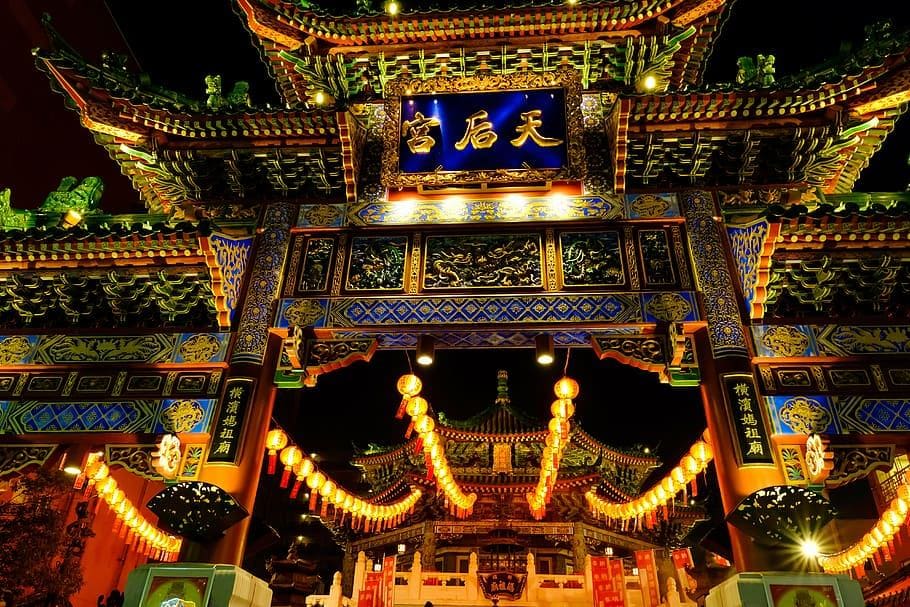
Yokohama, the capital of Kanagawa Prefecture and home to the largest Chinatown in Asia, is the best place to celebrate Lunar New Year(旧正月) in Japan. The main draw of this sprawling district, home to over 500 Chinese shops, is the food.
While some restaurants adjust their dishes to suit the Japanese palate, authentic Chinese flavors are still very much present. Nikuman (pork buns) sit alongside stalls grilling soup dumplings, while nearby, visitors line up for Hong Kong-style egg tarts and glossy Peking duck hanging in storefronts. Traditional Chinese mooncakes can also be found in souvenir shops.
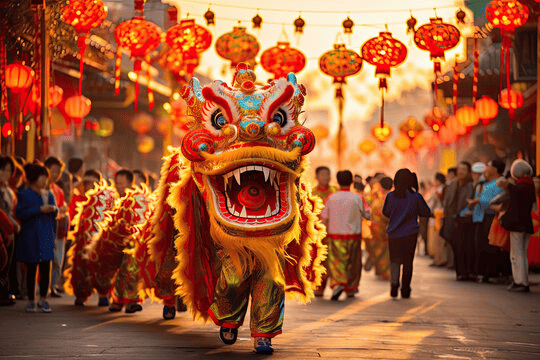
During the Lunar New Year(旧正月), the city takes the celebrations up a notch with vibrant lion and dragon dances showing off impressive acrobatics alongside colorful parades. There is even Spring Festival Illumination, which has the street decorated in vibrant lanterns, making the ornate architecture of Yokohama Chukagai even more spectacular.
2. Kobe Chinatown (Nankin-machi)
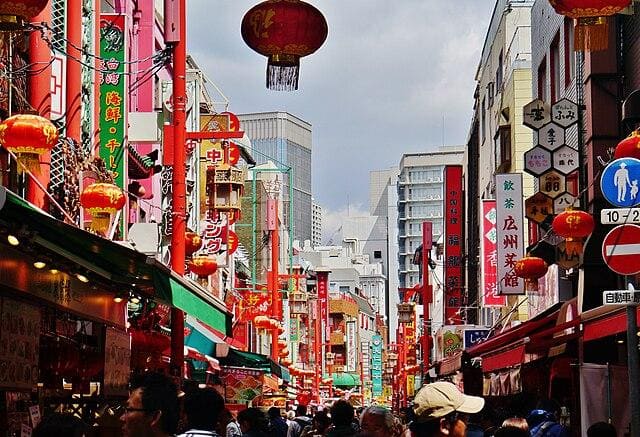
Kobe’s Chinatown, Nankin-machi, is a small but vibrant district that extends almost 300 meters east to west and roughly 100 meters north to south. The area, which still retains elements of traditional Chinese architecture, is packed with Chinese restaurants, street food stalls and souvenir shops.
The Lunar New Year(旧正月) is the biggest event in Nankin-machi, celebrated for one week each year according to the old lunar calendar. During this festival, the area comes alive with musical performances, lion dances, dragon dances and a colorful costume parade featuring famous figures from Chinese history.
In addition to the Lunar New Year(旧正月) festivities, Nankin-machi hosts several other cultural events throughout the year, including the Mid-Autumn Festival and the Nankin-machi Lantern Fair.
3. Nagasaki Chinatown (Shinchi Chukagai)
A bustling lane with over 250 shops and restaurants in downtown Nagasaki, Nagasaki Chinatown is Japan’s oldest chukagai, shaped by some of the country’s earliest immigrants. Chinese traders had settled in Nagasaki from the 17th to 19th century; at one point, over 10,000 residents had lived in the city.
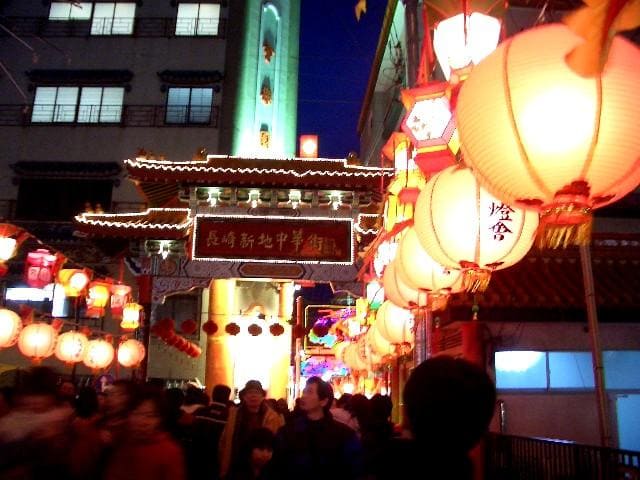
Today, the area retains historic structures, like the large red gates constructed by Chinese craftsmen, Chinese-style temples and buildings with hip-and-gable roofs.
It’s also home to one of Japan’s most breathtaking Lunar New Year(旧正月) celebrations. During the massive Lantern Festival, the streets glow with over 15,000 intricately crafted lanterns, from designs to towering installations shaped like Chinese zodiac animals of the year.
You can find notable Chinese-influenced dishes of chanpon and sara udon. For a more familiar taste, try Chinese braised pork nestled between fluffy, white steamed buns.
4. Ryukyu Islands
Historically, the Ryukyu Islands, which include Okinawa Prefecture and the Satsunan Islands, were a vital trading hub that connected Japan, China and Southeast Asia. The chain of 55 islands stretching from Kyushu to Taiwan is closer to Taipei and Shanghai than it is to Tokyo.
Although the Ryukyu Islands are part of Japan, their culture is distinctly different. Before being annexed by Japan, the kingdom maintained trade relations with China for centuries. Many Ryukyuan officials were descended from Chinese immigrants.
This Chinese influence is also why the Ryukyuan people are one of the few communities in Japan that still celebrate the New Year according to the lunar calendar — known as the Ryukyu New Year.
During this time, villages are filled with traditional performances, including classical music played on the sanshin, and tug-of-war and wrestling ceremonies. The streets echo with the sound of taiko drums and Eisa dancers. Like on New Year's Eve, the evening culminates in a grand fireworks display.
4 Things to do during Lunar New Year(旧正月) in Japan
A sure way to avoid overcrowded places is to head to lesser-known destinations. Thankfully, Japan has plenty of options. Our first few experiences bring you the best of Japan in a more intimate setting.
1. Make traditional Japanese sweets in Nagoya null
Just a few hours southwest of Tokyo, Nagoya is a too-often-overlooked city. It's home to a unique breakfast culture, the recently opened Ghibli Park, and the world's second-largest planetarium. When not looking at the stars or wandering Dondoko Forest, make your own Japanese confectionery (wagashi) and experience an authentic Japanese tea ceremony.
Delicate, beautiful, and delicious, Japanese wagashi sweets are a quintessential part of Japanese culture and a part of the ritual of any Japanese tea ceremony. This food experience offers the opportunity to learn how to make a range of Japanese sweets from scratch, diverse in their flavors and textures, and then enjoy them with a humbling Japanese tea ceremony experience.
2. Reconnect with nature on a farm in Mie Prefecture
Now, if you're open to a detour, let us recommend a once-in-a-lifetime experience in Mie Prefecture. Stay overnight at a farmer's inn in Taikicho and prepare dinner with the family. Harvest vegetables and mushrooms, cook rice with local spring water, and indulge in a sukiyaki hot pot with luxurious Matsusaka wagyu.
Collect water for the hot pot and rice at a local spring. This water is known as "miracle water" by neighboring residents, who say drinking it is their secret to a long life. Then, pick your veggies at a nearby vegetable patch. Lend a hand in making Japanese rice the old-fashioned way, starting by splitting wood for a fire.
The family uses a wood-fueled "kamado" stove to cook their rice, a tradition that used to be the norm in Japan but has since been replaced by electric rice cookers. The effort pays off, as steaming the rice using this method is said to bring out even more delicious flavors from the rice. The star ingredient of your meal will be Mie-raised Matsusaka wagyu, a protein that ranks in the top 3 Japanese beefs.
3. Customize your very own fake food sample in Tokyo
If you can't make it out of Tokyo, don't worry, we've got you. Take your food experiences a step further by making a unique fake food sample. Japanese fake food samples are a part of everyday life. You'll see them outside Japanese restaurants across the country, acting as a visual menu that entices hungry customers to come in.
In this workshop, you will learn how to make your very own fake food sample with the help of a friendly, professional teacher. Choose the default experience, and you'll make your own life-size ramen food sample. Alternatively, select one of the options and make an adorable tart charm, cupcake charm, or parfait.
4. Enjoy an evening luxury cruise in Tokyo Bay
The best way to see Tokyo's skyline at night? From a boat, of course! Board an elegant yakatabune (traditional Japanese "pleasure boat") for a private cruise and dining experience in Tokyo. Marvel at stunning views of Tokyo Bay, Odaiba, and Rainbow Bridge as you feast on a luxurious kaiseki meal. Accomplished chefs with experience gained at renowned hotels will showcase their culinary artistry right before your eyes.
This unique experience is pricey but worth every yen. Plus, it makes for a great date night activity if you're celebrating Valentine's Day with a loved one or marking a special anniversary.
The key to escaping the crowds during one of Japan's busiest periods is to go where nobody else is going. You can book hundreds of food experiences on by food in addition to the ones we suggested. Browse cooking classes, food tours and sake tastings.
Pro tip: Use the handy filters to find experiences suited to your trip and preferences.
The Japanese Lunar New Year(旧正月) is a fascinating blend of ancient traditions and modern adaptations. Although its official celebration has faded, its cultural footprints continue to shape Japanese society, offering a meaningful connection to the past and a richer understanding of seasonal and spiritual life in Japan.
Summary
The Japanese Lunar New Year(旧正月), or "Shōgatsu" (小正月), is a celebration that blends ancient customs with modern traditions, offering a fascinating look at Japan's historical and cultural evolution. From the significance of specific rituals to the foods that symbolize good fortune, the holiday highlights Japan’s reverence for nature, family, and renewal. As the holiday has evolved, it has embraced a mix of both Chinese influences and indigenous Japanese practices, reflecting the interconnectedness of Japan’s culture with the rest of Asia.
Interested in learning how this holiday shapes modern Japanese life and tradition! If you'd like to enjoy Lunar New Year(旧正月)in Japan, please feel free to contact us!